Inspection vs ISO Certification: What's the Difference?
Inspection and ISO certification answer different questions — and EIAC accredits the bodies that provide both. Here is how to tell which one your project needs.
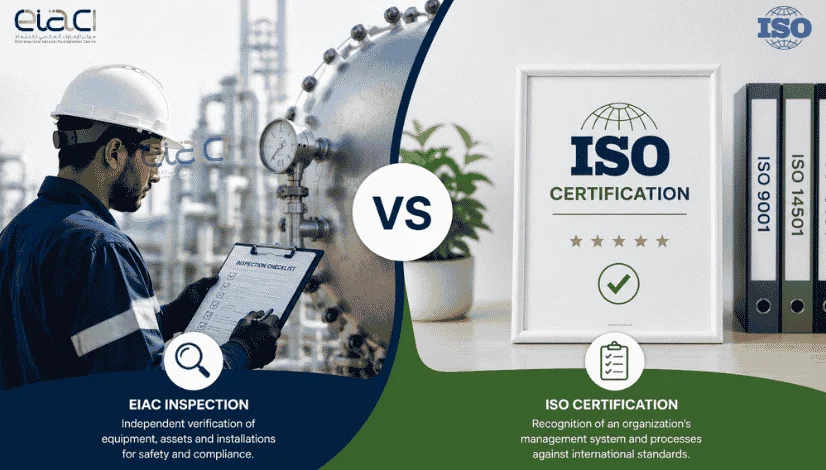
When organisations plan new projects or prepare for regulatory compliance, two terms come up repeatedly in procurement discussions: inspection and ISO certification. Because both involve accredited bodies and recognised standards, they are often treated as interchangeable.
They are not. And a third term — EIAC — is frequently misunderstood alongside them.
First, what EIAC actually does
The Emirates International Accreditation Centre (EIAC) is an accreditation body. It does not carry out inspections or issue ISO certificates.
What EIAC does is assess and accredit the organisations that provide those services — inspection bodies against ISO/IEC 17020, certification bodies against ISO/IEC 17021 and ISO/IEC 17065, and laboratories against ISO/IEC 17025.
So there is no such service as “EIAC inspection.” What exists is inspection performed by an EIAC-accredited inspection body — and the accreditation is what tells you the body was independently assessed as competent and impartial.
Understanding ISO certification
ISO certification evaluates how an organisation manages its processes.
An accredited certification body assesses whether a management system conforms to an international standard, such as:
- ISO 9001 — Quality Management
- ISO 14001 — Environmental Management
- ISO 45001 — Occupational Health and Safety
- ISO 22000 — Food Safety
- ISO 50001 — Energy Management
The audit examines documented processes, leadership, risk management, operational controls and continual improvement.
Certification does not inspect individual pieces of equipment or verify the physical condition of machinery. It assesses whether the organisation has established and maintains an effective management system.
Understanding inspection
Inspection works differently. An accredited inspection body carries out an independent technical examination of equipment, products, installations or systems to determine whether they meet specified technical, regulatory, contractual or safety requirements.
Inspection activities may include:
- Crane inspection
- Lifting gear inspection
- Pressure vessel and boiler inspection
- Storage tank and pipeline inspection
- Vendor inspection and expediting
- Non-destructive testing
- Helium leak testing
The objective is an impartial assessment of the item itself, not of the organisation that owns it.
The key difference
Both support quality and confidence, but they answer different questions.
| Inspection | ISO certification |
|---|---|
| Evaluates equipment, assets, installations or products | Evaluates an organisation’s management system |
| Confirms technical compliance for specific activities | Confirms conformity with an ISO management system standard |
| Project, asset or equipment specific | Organisation-wide |
| Supports operational safety and technical verification | Supports continual improvement and effective management |
| Performed by a body accredited to ISO/IEC 17020 | Performed by a body accredited to ISO/IEC 17021 or 17065 |
In short: inspection looks at what you have. Certification looks at how you manage.
Can an organisation need both?
Frequently, yes. The two complement rather than replace each other.
A construction company may hold ISO 9001 and ISO 45001 certification to demonstrate effective management systems, while also requiring independent inspection of cranes, lifting equipment and pressure systems before they can be used safely. An industrial manufacturer may maintain certification while arranging periodic third-party inspection of critical production equipment.
When to choose inspection
Consider independent inspection when you need objective verification of a physical asset or installation:
- Before commissioning equipment
- During periodic statutory inspections
- Following repairs or modifications
- Before project handover
- During supplier or vendor inspections
- To satisfy contractual or regulatory requirements
Inspection confirms that the item examined meets applicable technical requirements at the time of inspection.
When to choose ISO certification
Certification is appropriate when an organisation wants to demonstrate that its management system aligns with an international standard. It is often required when:
- Tendering for contracts
- Meeting customer requirements
- Strengthening risk management
- Demonstrating commitment to continual improvement
- Supporting sustainability and governance objectives
Which one is right for your organisation?
If you need assurance that equipment or installations comply with technical requirements, independent inspection is the answer. If you need to demonstrate an effective management system aligned with an ISO standard, certification is. Many organisations need both, because they address different aspects of the same operation.
Frequently asked questions
Does EIAC carry out inspections? No. EIAC is an accreditation body. It assesses and accredits the inspection bodies, certification bodies and laboratories that carry out the work. Inspection is performed by an EIAC-accredited inspection body, not by EIAC itself.
Is inspection the same as ISO certification? No. Inspection verifies the condition or compliance of equipment, products or installations. ISO certification assesses an organisation’s management system against an international standard.
Does ISO certification replace equipment inspection? No. Certification does not satisfy statutory, contractual or technical inspection requirements. Many organisations need both.
Why does accreditation matter when choosing a provider? Accreditation means the body has been independently assessed for competence, impartiality and consistency against the relevant ISO/IEC standard. It is what makes the resulting report or certificate credible to regulators and clients.
Which industries commonly require inspection services? Construction, engineering, manufacturing, oil and gas, utilities, logistics, marine and infrastructure projects regularly require independent inspection.
How do I know which my project needs? Review your contractual obligations, applicable regulations and project specifications. If it remains unclear, ask an accredited provider before committing.
Talk to our technical team or explore our inspection services.
This article is provided for information only and does not constitute professional or compliance advice. ITMAD accepts no liability for any action taken in reliance on it.