Tower Crane Inspection: What Gets Examined, and When
Tower crane inspection is triggered by events, not just the calendar. What a thorough examination covers, the safety devices that matter, wire rope discard criteria, and the defects that actually turn up on UAE sites.
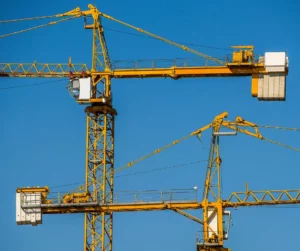
Tower crane inspection gets treated as a periodic box to tick. It isn’t. The inspections that matter most are triggered by events — erection, climbing, modification, severe weather — and missing one of those is how cranes fail.
When inspection is required
After erection, and after every climb. A tower crane is a different structure after each climbing operation. Mast bolt torque, tie-in collars, and slewing ring fixings all need verification before the crane returns to service. This is the highest-risk moment in a tower crane’s life on site.
Periodically in service. Interval depends on the crane, duty cycle and what the specification requires. Twelve months is a common baseline for thorough examination; heavy-duty or high-cycle applications warrant shorter.
After modification or repair. Any change to structure, hoisting system, or safety devices requires re-examination before the crane is used.
After exceptional events. Severe wind, an overload event, a collision, or any incident affecting the structure. In the UAE, out-of-service wind events are the common trigger — a crane left improperly weathervaned can be structurally affected without visible damage.
Before dismantling. Often overlooked. Structural condition affects how the crane can safely be taken down.
What a thorough examination covers
Structure
- Mast sections, and the condition and torque of connecting bolts and pins
- Tie-in collars and their fixings to the permanent structure
- Slewing ring and slewing ring bolts — bolt tension loss here is one of the more serious findings and is not visible without checking
- Jib and counter-jib members, pendant bars and their end connections
- Welds at high-stress locations
- Corrosion, particularly at connections and where water collects
Mechanical
- Hoist, slewing and trolley gearboxes
- Brakes on all motions — condition, adjustment, and function
- Wire ropes: hoisting, trolley and pendant
- Sheaves and drums — groove wear, flange condition
- Hook, hook block and safety catch
- Counterweight condition and securing
Wire ropes specifically
Wire rope inspection follows defined discard criteria — ISO 4309 is the usual reference for care, maintenance, inspection and discard of crane ropes. Assessment covers broken wires within a reference length, diameter reduction, corrosion, deformation, and damage at terminations.
Rope condition is where “looks fine” and “meets discard criteria” most often diverge. It should be measured, not eyeballed.
Electrical and safety devices
This is where inspections are most often shallow, and where the consequences are most direct:
- Load moment indicator (LMI) — function and calibration. Drift is common and not self-evident.
- Overload cut-out
- Hoist upper and lower limit switches
- Trolley in and out limits
- Slewing limits, where fitted
- Anemometer — function and alarm setting
- Control systems, emergency stop, cabin instrumentation
- Lighting, aircraft warning lights where required
Testing that a safety device is present is not the same as testing that it functions at the right setpoint. Ask which was done.
Foundation and base
- Foundation condition, base frame or fixing angles
- Anchor bolts
- Ballast, quantity and placement, where applicable
- Level and plumb — tower verticality within tolerance
- Drainage and standing water at the base
Load testing
Load testing verifies performance under controlled load, typically at erection, after major repair, or where the specification requires it.
Two things worth being clear on before it happens: the test load and its position — which determine the moment applied, not just the mass — and the acceptance criteria. Both come from the manufacturer’s data and the applicable standard, not from convention.
Load testing does not replace thorough examination. A crane can pass a load test with a rope approaching discard criteria or an LMI reading 15% low.
Commonly specified standards
Your specification should name which applies:
- BS 7121 — safe use of cranes, including tower cranes and the inspection, maintenance and thorough examination series
- ASME B30.3 — tower cranes, where US codes are specified
- ISO 4309 — wire rope inspection and discard criteria
- Manufacturer’s manual — which takes precedence on crane-specific requirements, tolerances and torque values
Where standards conflict, the more stringent requirement generally applies. Confirm rather than assume.
Defects that actually turn up
From routine examinations, the recurring ones:
- Slewing ring bolt tension loss — serious, and invisible without checking
- Wire rope broken wires concentrated near terminations or at points of repeated bending
- LMI calibration drift — the crane reports less load than it is lifting
- Anemometer failure, often unnoticed because nobody checks the reading against conditions
- Tie-in collar fixings loosened or improperly installed after climbing
- Corrosion at pin joints and mast connections, accelerated in coastal humidity
- Missing or damaged hook safety catch — trivial to fix, common finding
- Documentation gaps — no manufacturer’s manual on site, no record of previous examination, no repair history
The last one causes more delay than any mechanical defect. An inspector who cannot establish the crane’s history cannot certify its condition.
What to ask an inspection provider
- Which standard will the examination be carried out to?
- Will safety device setpoints be functionally tested, or only checked for presence?
- Will wire ropes be assessed against ISO 4309 discard criteria, with measurements recorded?
- What are the inspector’s qualifications for tower cranes specifically?
- What does the report contain — findings, criteria applied, photographic evidence, and a clear statement of condition?
- What is the turnaround? On an active site a report three days late is a report three days of delay.
A report that says “satisfactory” with no supporting detail is not evidence of anything.
Common questions
How often does a tower crane need thorough examination? Twelve months is a common baseline, but the interval should reflect duty cycle and specification. Event-triggered examinations — after erection, climbing, modification, or exceptional events — are separate from and additional to the periodic cycle.
Is a load test the same as a thorough examination? No. A load test verifies performance under load. A thorough examination assesses the condition of structure, mechanism, ropes and safety devices. Each can pass while the other fails.
Does the crane need re-examination after climbing? Yes. Climbing changes the structure. Bolt torque, tie-in collars and verticality all need verification before return to service.
What documents should be on site? Manufacturer’s manual, previous examination reports, repair and modification records, and load charts. Their absence delays examination and limits what any inspector can certify.
Request a crane inspection proposal — tell us the crane type, model and what your specification requires. See also our crane inspection and lifting gear inspection services.
This article is provided for information only and does not constitute professional or compliance advice. ITMAD accepts no liability for any action taken in reliance on it.